How do you know if your digital platform is ready for Series B?

For founders and leadership teams approaching a Series B raise, the question isn’t just “Do we have traction?” but “Is our digital platform genuinely ready for the next stage of growth?” Investors at this level look for scalable foundations and they want evidence that your technology, experience and go-to-market systems can support rapid expansion without tripping over avoidable friction and risk.
In this context, “digital platform” doesn’t mean a single website or product surface. We’re talking about the broader digital ecosystem that enables growth, spanning your core product, your website and acquisition journeys, and the data and Martech infrastructure that connects them. Series B readiness depends on how well these elements work together under pressure.
At Polar London, we often see scaling businesses overlooking subtle but critical issues in their digital ecosystems. These gaps become glaring under pressure, whether driving acquisition, supporting international launches, or integrating AI and Martech. Below is a practical readiness checklist with diagnostic framing you can use to assess your platform before pitching for Series B.
1. Platform debt: can you scale without breaking?
Technical debt is the silent growth killer. It shows up as:
- Monolithic code and brittle deployments — every release feels risky.
- Outdated frameworks, plugins or custom hacks — slow performance and unclear ownership.
- Patchwork integrations across systems — data loss, mismatched user identity, manual fixes.
Ask yourself:
- Can new features be delivered in weeks, not months?
- How long do deployments take, and how often do they break something else?
- Is your infrastructure observable and automated?
If you’re still firefighting basic tech issues, investors will see risk, not readiness.
2. UX fragmentation: does your users’ journey hold together?
A fragmented user experience undermines growth because it makes value harder to realise. Common signs include:
- Inconsistent journeys across devices or channels — users drop off or get confused.
- Multiple sign-in points and profiles that don’t sync — poor engagement and measurement gaps.
- Content and product experiences feel disconnected — support tickets go up as self-serve fails.
Your UX should feel one coherent system from discovery to conversion and retention. If different parts of your product or site feel like separate products, that’s a red flag.
3. Diagnostic checklist: UX health markers
- Journey clarity: Can someone unfamiliar with your product complete key tasks with minimal friction?
Time to value: How quickly can a new user get to that “aha” moment? - Consistency: Do language, design and interactions feel cohesive across every surface?
Where the answers here are weak, your platform isn’t positioned for the scale Series B demands.
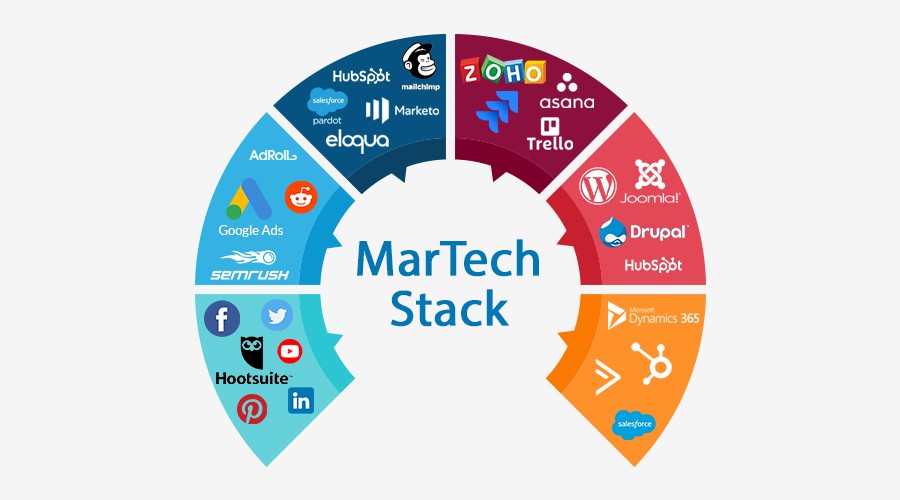
4. Martech gaps: are you missing the connective tissue?
Martech isn’t just a buzzword — it’s the glue that turns user activity into insights, automation and growth.
Common gaps we see include:
- Disconnected events and tracking — search, forms, flows are measured differently or not at all.
- Data silos between product, web and CRM — marketing can’t act on what it can’t see.
- Weak activation loops — no adaptive personalisation, limited predictive signals.
A strong Martech foundation means your platform:
- Captures consistent events across channels,
- Identifies users and accounts early,
- Feeds those signals into segmentation, automation, and scoring.
Without that, you’re flying blind and Series B investors don’t like blind spots.
5. Hidden risk: what’s lurking below the surface?
Not all risk is obvious. Some only shows up when an investor — or a sudden surge of traffic, new integrations, or market expansion — puts pressure on your systems.
Be alert for:
- Security vulnerabilities in legacy code or third-party dependencies
- Unclear access controls and permissions as teams scale
- Manual workarounds that don’t scale
- Non-compliant data practices (privacy, consent, retention)
- No fallback, incident response, or disaster recovery plans
A Series B-ready platform anticipates failure modes, tests them regularly, and has plans ready to execute.
6. Readiness scorecard (quick diagnostic)
Use this simple diagnostic framework to assess readiness:
| Category | Red Flag | Amber | Green |
| Tech & architecture | Frequent failures; long release cycles | Mostly stable; occasional issues | CI/CD; observability; automated tests |
| UX & journeys | Fragmented; drop-off | Some smooth areas; some friction | Consistent, predictable flows |
| Tracking & data | Missing events; silos | Partial signals, limited integration | Unified schema, real-time signals |
| Martech & automation | Manual, reactive | Basic automation | Predictive, adaptive, tied to outcomes |
| Risk & compliance | Unknown vulnerabilities | Known issues, no plan | Policies, audits, recovery strategy |
If too many boxes sit in Red or Amber, your platform still has work to do before it can support the demands and scrutiny that come with Series B fundraising.
7. Tell a compelling story to investors
Being ready isn’t just about fixing everything. It’s about framing it in a way that:
- Shows what you’ve already solved
- Highlights where impact will be realised next
- Connects product health to revenue, retention and margin improvement
Investors want confidence that your platform isn’t a bet — it’s a lever for growth. That means clear evidence, structured maturity and a roadmap with measurable outcomes.
A digital ecosystem that reliably delivers great experiences, supports rapid feature release, and turns user behaviour into meaningfully actionable signals is a platform that inspires confidence, both in your customers and in your Series B audience.

If you’d like to assess your readiness in more detail, you can start with our Growth Stress Test, a short diagnostic designed to benchmark your digital ecosystem against growth-stage expectations.
We’re also happy to talk through the results and what they mean in practice.