Tag: sustainable

A diagnostic for founders, CEOs and boards at Series B / pre-investment
Scaling is intoxicating. Investors talk about growth, GTM efficiency and network effects; product teams dream in new features; marketing plans promise explosive reach. But the uncomfortable truth what keeps CEOs and boards awake is whether your digital estate can carry that ambition without collapsing under its own weight.
Why the question matters
At Series B and in pre-investment diligence, growth expectations become binary: either your platform can reliably convert more users and serve them at lower marginal cost, or the business is adding churn and technical overhead faster than revenue. Investors often under-estimate digital risk because the surface metrics look healthy traffic, downloads, ARR while the underlying systems and processes are fragile.
Scaling without repairing these weaknesses multiplies three costs:
- Acquisition waste — new users are lost through broken journeys or inconsistent UX.
- Operational drag — platform debt increases maintenance and slows roadmap velocity.
- Value leakage — poor measurement, fragmented Martech and data gaps mean you can’t prove unit economics.
So the right frame is not “can we build more features?” but “can the business survive added volume, complexity and scrutiny?”
Four domains that decide scale readiness
Any credible readiness check focuses on four places where scale fractures first.
1. Platform health and platform debt
Look for brittle integrations, sprawling undocumented APIs, low automated test coverage and ad-hoc scripts that keep things running. Key signals:
- High mean time to recover (MTTR) for incidents.
- Large, coupling-heavy modules that cannot be deployed independently.
- Production hot-fixes more common than planned releases.
2. User experience and journey integrity
Fragmented UX isn’t an aesthetic problem — it’s a conversion and trust issue. Signs of trouble:
- Multiple ways to do the same thing with inconsistent outcomes.
- Unknown or high friction in key flows (signup, onboarding, payment).
- Accessibility, localisation and device gaps.
3. Martech, measurement & insight gaps
Growth stops being repeatable when you can’t measure what matters. Watch out for:
- No single customer view; identity stitching is ad-hoc.
- Tagging chaos in tag managers and duplicated events.
- Disconnected attribution and cohort analysis.
4. Governance, risk and hidden dependencies
These are often invisible until they fail. Examples:
- Third-party vendors critical to revenue with no SLAs.
- No documented incident playbooks, backups or runbooks.
- Unverified compliance (GDPR, PCI) in customer-facing flows.
The readiness checklist investors will reward
Score each item 0–3 (0 = not present, 3 = mature). Total out of 30.
- Critical flow availability — monitored and paged for (signup, checkout, auth).
- Automated testing — unit, integration and end-to-end coverage for core flows.
- Release safety — CI/CD with canary/blue-green deployments and rollback.
- Observability — structured logs, tracing, SLOs and dashboarding for core metrics.
- Data quality & single customer view — identity resolution and reliable user events.
- Martech hygiene — single tag manager, versioned events, documented mapping.
- UX consistency — documented design system and shared component library.
- Security & compliance — pen tests, PCI/GDPR posture, dependency scanning.
- Dependency map — inventory of third-party services and critical SLAs.
- Operational maturity — incident runbooks, run rate for bugs, and on-call readiness.
Interpretation:
0–9 = Red: Significant structural deficits. Pause scale; prioritise stabilisation.
10–20 = Amber: Partial readiness. Tactical fixes will help, but risk remains.
21–30 = Green: Low digital risk for immediate scale; consider targeted hardening.
Why scaling before fixing foundations destroys ROI
A short example: if you boost acquisition spend by 30% but conversion through checkout falls by 10% because of a fragile payment integration, your marginal cost per paying customer rises. Add in the operational cost of firefighting and the delay to ship core retention work, and the ROI on that acquisition spends collapses.
Fixing foundations is not an expensive luxury — it is protecting the multiple investors who are buying. It reduces churn, increases conversion and shortens the runway for new initiatives. In short: the safest way to scale revenue sustainably is to shrink the denominator of waste before you expand the numerator of growth spend.
From MVP to scale: what breaks first (and how to triage)
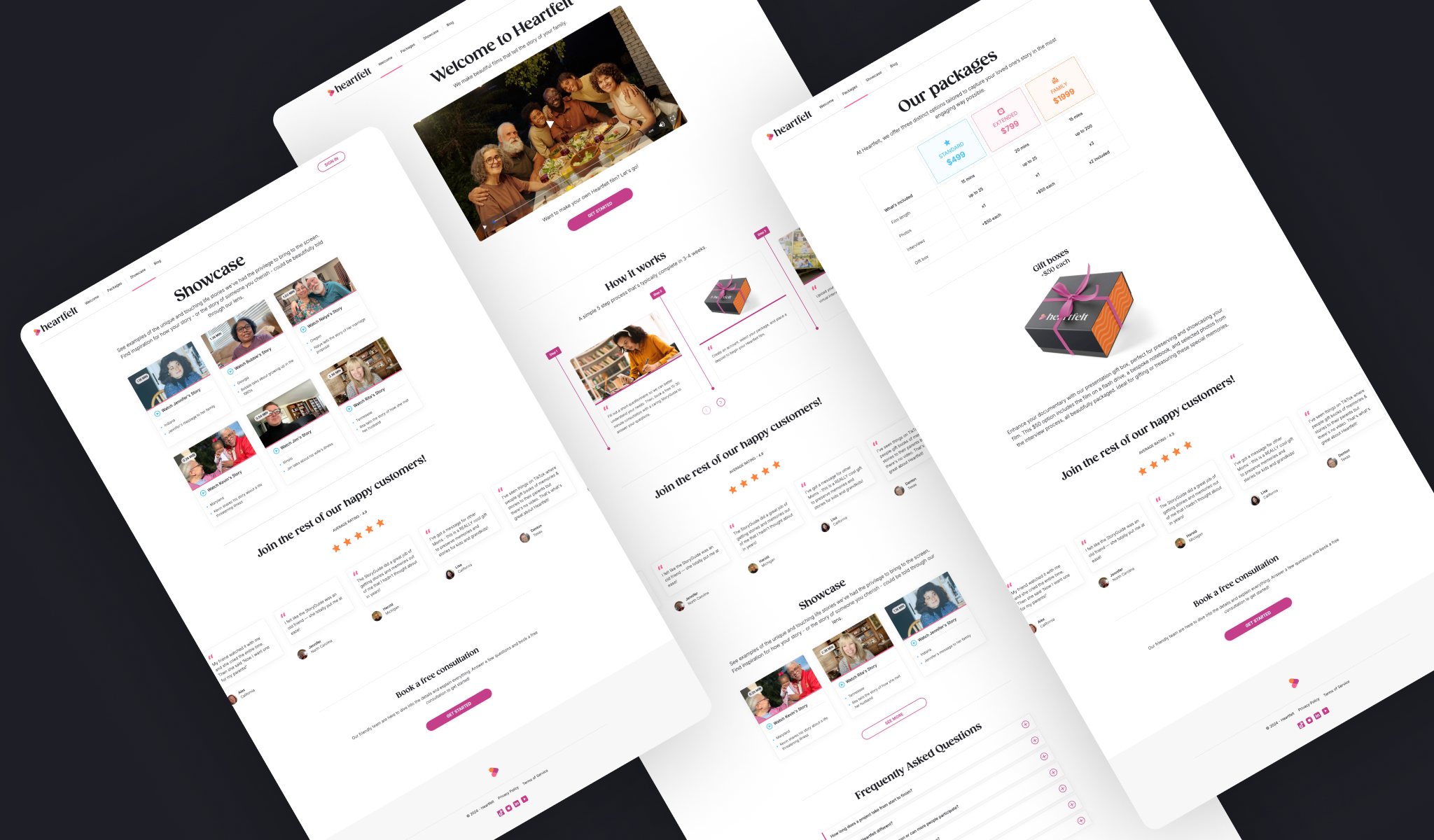
In our work helping teams scale digital ecosystems — including projects like Heartfelt.film, where growth depended on connecting experience, data and platform foundations — we see a common failure sequence emerge in fast-growing digital estates:
Typical failure sequence in fast-growing digital estates:
- Identity & billing — authentication, session handling and payment edge-cases surface first.
- Search, cache & performance — increases in load reveal caching or search bottlenecks.
- Analytics integrity — events get lost or double-counted when traffic rises.
- Third-party rate limits — external dependencies fail under real traffic patterns.
- Fragmented UX — new features patched onto old flows create inconsistent experiences.
Triage approach: stop new feature launches for 1–2 sprints; stabilise critical flows; harden infra and add observability; then resume growth with controlled experiments.
A practical three-week diagnostic (what to do now)
Week 1 — Rapid audit (executive one-pager)
- Run the 10-item checklist and collect evidence (screenshots of dashboards, key incident logs, event samples).
- Map top 5 user journeys and identify failure modes.
Week 2 — Quick wins
- Lock down tagging, restore single customer view for the last 30 days.
- Harden payment and auth flows with focused reliability tests.
- Add basic SLOs for the three most critical endpoints.
Week 3 — Roadmap & de-risk
- Produce a 90-day stabilisation roadmap: platform debt reductions, UX fixes, and a Martech clean-up.
- Quantify expected ROI from each stabilisation (reduced churn, improved conversion).
This diagnostic produces a single-page readiness rating for the board and a one-page plan for investors.
If you’d like support running this as a low-risk pilot, Polar can deliver the diagnostic end-to-end with your product, engineering and growth teams — giving you clear evidence of readiness and a practical plan to de-risk the next phase of growth. Get in touch to discuss a pilot.
The questions investors don’t ask — but absolutely should
Investors often ask about ARR and growth metrics; these are necessary but not sufficient. The missing questions are:
- What is the true cost to serve a new user in production?
- Do you have a reliable single customer view for cohort analysis?
- What vendor would you lose first if it became unavailable?
- How long to restore service for critical flows and why?
- Which metrics are synthetic (prone to error) versus reliable?
Answering these gives confidence beyond PR numbers.
Final word: frame your move to scale as risk-reduction, not delivery
Scaling is an act of trust: you ask investors to trust your infrastructure, customers to trust your product, and your team to trust your processes. Treat the digital estate as a risk portfolio. The smartest move is to de-risk critical flows first, then accelerate.
If you want a focused, board-level one-page readiness report and a three-week de-risk roadmap, start with the checklist above and quantify the top three risks by potential revenue impact. That single sheet will change the conversation from “can we grow?” to “how do we grow safely?”
Polar’s point of view is simple: make sure your platform is flawless under fire — not because you want perfection, but because the economics of scale punish brittle systems.
If you’d like a quick benchmark before you dive deeper, take the Polar Growth Stress Test. It’s a short diagnostic designed to highlight where your digital ecosystem is most likely to break under Series B-level scale.

For founders and leadership teams approaching a Series B raise, the question isn’t just “Do we have traction?” but “Is our digital platform genuinely ready for the next stage of growth?” Investors at this level look for scalable foundations and they want evidence that your technology, experience and go-to-market systems can support rapid expansion without tripping over avoidable friction and risk.
In this context, “digital platform” doesn’t mean a single website or product surface. We’re talking about the broader digital ecosystem that enables growth, spanning your core product, your website and acquisition journeys, and the data and Martech infrastructure that connects them. Series B readiness depends on how well these elements work together under pressure.
At Polar London, we often see scaling businesses overlooking subtle but critical issues in their digital ecosystems. These gaps become glaring under pressure, whether driving acquisition, supporting international launches, or integrating AI and Martech. Below is a practical readiness checklist with diagnostic framing you can use to assess your platform before pitching for Series B.
1. Platform debt: can you scale without breaking?
Technical debt is the silent growth killer. It shows up as:
- Monolithic code and brittle deployments — every release feels risky.
- Outdated frameworks, plugins or custom hacks — slow performance and unclear ownership.
- Patchwork integrations across systems — data loss, mismatched user identity, manual fixes.
Ask yourself:
- Can new features be delivered in weeks, not months?
- How long do deployments take, and how often do they break something else?
- Is your infrastructure observable and automated?
If you’re still firefighting basic tech issues, investors will see risk, not readiness.
2. UX fragmentation: does your users’ journey hold together?
A fragmented user experience undermines growth because it makes value harder to realise. Common signs include:
- Inconsistent journeys across devices or channels — users drop off or get confused.
- Multiple sign-in points and profiles that don’t sync — poor engagement and measurement gaps.
- Content and product experiences feel disconnected — support tickets go up as self-serve fails.
Your UX should feel one coherent system from discovery to conversion and retention. If different parts of your product or site feel like separate products, that’s a red flag.
3. Diagnostic checklist: UX health markers
- Journey clarity: Can someone unfamiliar with your product complete key tasks with minimal friction?
Time to value: How quickly can a new user get to that “aha” moment? - Consistency: Do language, design and interactions feel cohesive across every surface?
Where the answers here are weak, your platform isn’t positioned for the scale Series B demands.
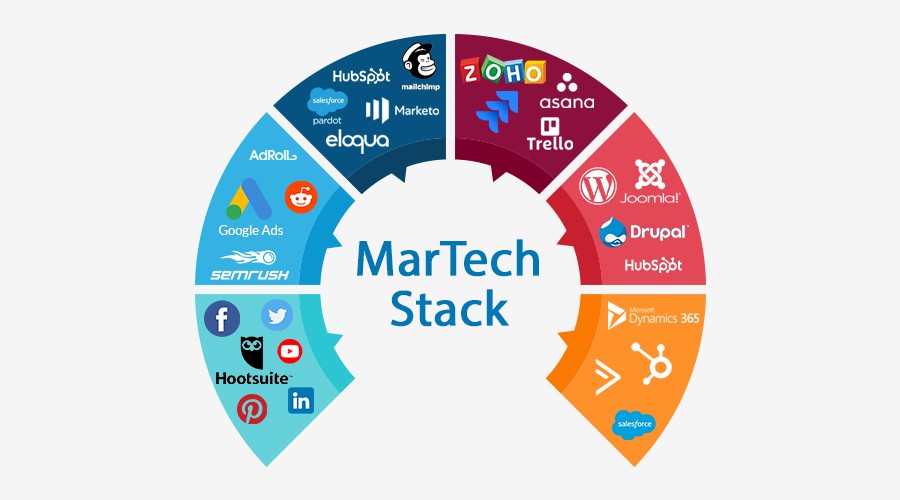
4. Martech gaps: are you missing the connective tissue?
Martech isn’t just a buzzword — it’s the glue that turns user activity into insights, automation and growth.
Common gaps we see include:
- Disconnected events and tracking — search, forms, flows are measured differently or not at all.
- Data silos between product, web and CRM — marketing can’t act on what it can’t see.
- Weak activation loops — no adaptive personalisation, limited predictive signals.
A strong Martech foundation means your platform:
- Captures consistent events across channels,
- Identifies users and accounts early,
- Feeds those signals into segmentation, automation, and scoring.
Without that, you’re flying blind and Series B investors don’t like blind spots.
5. Hidden risk: what’s lurking below the surface?
Not all risk is obvious. Some only shows up when an investor — or a sudden surge of traffic, new integrations, or market expansion — puts pressure on your systems.
Be alert for:
- Security vulnerabilities in legacy code or third-party dependencies
- Unclear access controls and permissions as teams scale
- Manual workarounds that don’t scale
- Non-compliant data practices (privacy, consent, retention)
- No fallback, incident response, or disaster recovery plans
A Series B-ready platform anticipates failure modes, tests them regularly, and has plans ready to execute.
6. Readiness scorecard (quick diagnostic)
Use this simple diagnostic framework to assess readiness:
| Category | Red Flag | Amber | Green |
| Tech & architecture | Frequent failures; long release cycles | Mostly stable; occasional issues | CI/CD; observability; automated tests |
| UX & journeys | Fragmented; drop-off | Some smooth areas; some friction | Consistent, predictable flows |
| Tracking & data | Missing events; silos | Partial signals, limited integration | Unified schema, real-time signals |
| Martech & automation | Manual, reactive | Basic automation | Predictive, adaptive, tied to outcomes |
| Risk & compliance | Unknown vulnerabilities | Known issues, no plan | Policies, audits, recovery strategy |
If too many boxes sit in Red or Amber, your platform still has work to do before it can support the demands and scrutiny that come with Series B fundraising.
7. Tell a compelling story to investors
Being ready isn’t just about fixing everything. It’s about framing it in a way that:
- Shows what you’ve already solved
- Highlights where impact will be realised next
- Connects product health to revenue, retention and margin improvement
Investors want confidence that your platform isn’t a bet — it’s a lever for growth. That means clear evidence, structured maturity and a roadmap with measurable outcomes.
A digital ecosystem that reliably delivers great experiences, supports rapid feature release, and turns user behaviour into meaningfully actionable signals is a platform that inspires confidence, both in your customers and in your Series B audience.

If you’d like to assess your readiness in more detail, you can start with our Growth Stress Test, a short diagnostic designed to benchmark your digital ecosystem against growth-stage expectations.
We’re also happy to talk through the results and what they mean in practice.

INTRO: CAN WEB DESIGN BE SUSTAINABLE?
In this article, we’ll take apart what sustainable web design and development actually means, and how to work with your agency to begin to apply it. We’ll also attempt to shed some light on the “why’s” of this revolution. But most importantly, where it all derives from. And that is sustainability as an overall motto to go through life and do business. Within or outside web development. And how that new age gold standard must become something more than just “a nice PR tactic”.
Our future generations and the planet, need companies to own sustainability and embrace it from their corporate DNAs.
Once that truthful foundation is solidified, then we can start applying those core guidelines to everything else, such as web design. Not many people know this, but Web Design has indeed its own Sustainability Manifesto, which sets a gloomy tone by starting with a sad phrase: “If the Internet was a country, it would be the 7th largest polluter”.
THE GREEN REVOLUTION: THE BIRTH OF SUSTAINABILITY AS A WHOLE
Some people can track this movement back to the 80s, others attribute it to the 90s, but being sustainable and caring for the planet, the people and their future has been on some agendas for decades. What shifted the tide was things such as global warming, the tech revolution, population growth, and food consumption rising, all a massive impact on the Earth. Many of those are causes and many consequences.
It is a world stage where much info is thrown among supporters and discreditors, but one thing is for sure. The Earth is not getting any better and something has to be done.
Like any movement, it starts with people that are genuinely interested in the topic, and once the issue takes the media spotlight with Governments and large companies understanding its importance, it becomes “a thing”.
Now, it has become “a thing” accounting for emissions and becoming carbon neutral.
Firstly, these rules applied to the main products each company manufactured (being simplistic), but what about the total impact a company has just for the sake of existing? If looked at through these optics, anything can become greener. Even things like the entire industry of web development, design, UX and all its aspects.
SUSTAINABLE PRACTICES AS THE KEY TO A BETTER FUTURE
We already discussed major breakthroughs in technology reaching mass adoption. Like the metaverse for example. If you want to delve deeper into this fascinating world, you can read the full article here:

But even though connectivity and globalism are great, heavily relying on crypto is not making our carbon footprint lower. In fact, quite the opposite. But there is a way where instead of evolving mankind at the cost of its own future, by paying attention and becoming more efficient in sustainable practices we can evolve INTO a future, instead of at the expense of it. When applied to Web Design, Sustainable Web Design was born.
WHAT DOES SUSTAINABILITY MEAN FOR WEB DESIGN?
Sustainable Web Design means applying sustainability principles not only to the design process itself, but with a deep cleansing that involves private data handling, the energy consumption of resources, products and services’ footprint, and many more things. To understand it properly we can take a look at the manifesto. An amazing document that we, at Polar London, have been relying on for quite some time, and we wanted to share it with you.
It stands on top of 6 pillars: clean, efficient, open, honest, regenerative, and resilient. If you still don’t know what that means, don’t worry. We’ll cover them all.
- Clean means that ALL services used and provided will be powered by renewable energies.
- Efficient means that ALL products and services provided will use the least amount of resources possible.
- Open means that ALL products and services will be accessible and allow their users to control their data at any time.
- Honest means that ALL products and services provided will not exploit nor mislead users.
- Regenerative (the toughest one) means that ALL products and services provided will support an economy that nourishes people and the planet.
- And lastly, Resilient means that the products and services provided will function in the times and places where people need them the most.
As you can see, these principles are indeed much deeper than what their simplicity implies.
HOW DO WE APPLY THESE SUSTAINABILITY PRINCIPLES?
Major changes never happen overnight, but it is true that if all of the internet applied these principles it wouldn’t be a sustainable concern for our future. But it takes baby steps, and bold companies and agencies to take the lead in the right direction. Even if you don’t feel a particular way of executing a project will save the world, you have to change your mindset and start believing that because of that, you are contributing to a better future. That small shift can make a universal difference.
“A sustainable mindset from kickoff is the approach we take at Polar London”.
Alex Birch 22
Even though not all principles can be applied and maxed out at the same time, many things can be done -and we started doing it long ago- to contribute. Why? Because We owe it to our future and our clients.
Perhaps you can draw some inspiration from us and become a bit more sustainable from learning how we actually contribute.

- We are remote-first! Ensuring a lower carbon footprint.
- We thoroughly assess where the discussed principles can be tangibly applied when we approach best practices.
- We make sure our clients understand the importance and impact of these choices.
- We inspect and criticise each phase of the website process (UX, Design, Development) to detect small and big wins that can be applied. From faster page load speed, improved accessibility, and showing the emissions of that specific website. Creating sustainability awareness is also a way to succeed.
Sustainable Web Design is powerful, impactful, real, and meaningful. And we are the ones that can increase its abilities or completely sever them.
For those wanting to learn more, we found a great podcast series around “World Wide Waste” with Gerry McGovern which talks about the “Perils of e-waste and benefits of being a digital vegan“.
We know on which side we stand, what about you?
If you are interested in applying sustainable design and development to your business, processes, or companies, let’s talk!